Screen colour tolerance
A colour field across approximate hues from ≈ 400 to 700 nm with adjustable brightness. The participant indicates the hue at which they feel discomfort.
LightSound Lab 05 · Research prototype
A light–sound research prototype for professionals working within an approved study: four slow, flash-free procedures with a clean participant screen, pseudonymised session records and data export for analysis.
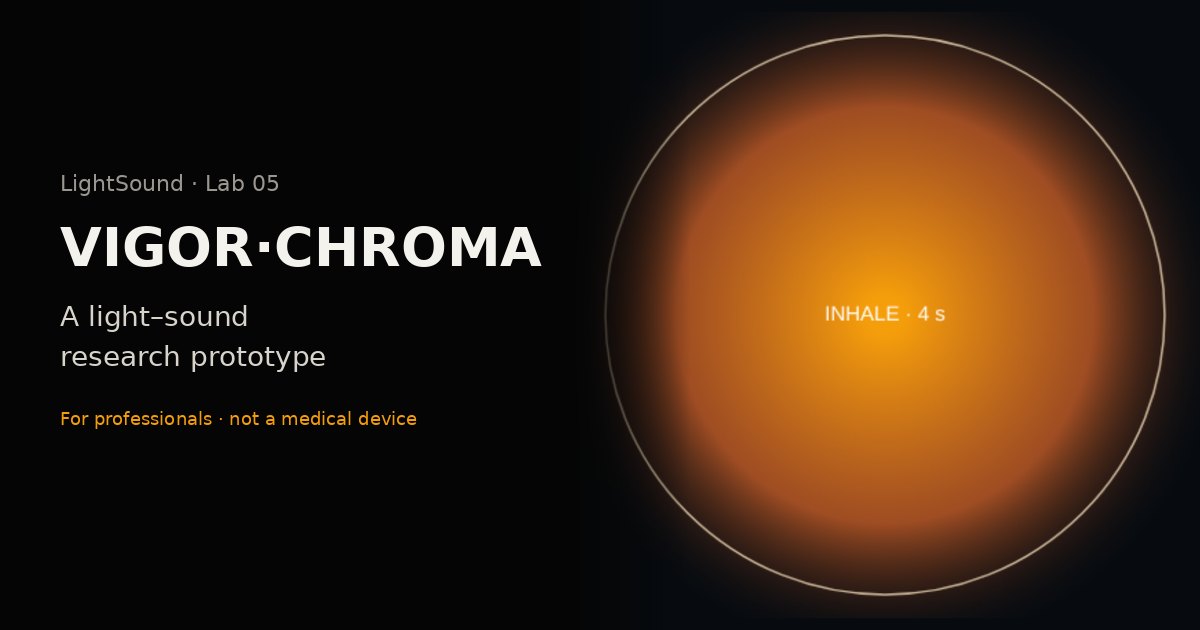
VIGOR·CHROMA is a research prototype. It does not diagnose, does not treat and gives no basis for choosing optical filters. It is intended only for professionals — physicians, clinical psychologists and researchers — working within a protocol approved by an ethics committee, with the participants’ informed consent.
The prototype lets a research team try out, in a standard and documented way, how people respond to slow coloured light and sound: which screen hues they find uncomfortable, how they choose a colour for their state before and after a procedure, and how they experience a paced breathing field or bilateral motion. Whether any of this has clinical value is a question for the study, not an assumption of the program.
A colour field across approximate hues from ≈ 400 to 700 nm with adjustable brightness. The participant indicates the hue at which they feel discomfort.
The participant chooses a colour for their state before and after a procedure in CIE LAB; the change is shown as ΔE₀₀ (CIEDE2000).
A warm amber field that expands and contracts at about six breaths a minute, with an optional quiet tone. A metronome, not biofeedback.
A soft point of light moving horizontally or in a figure of eight at 0.1–0.4 Hz, with the tone panned in stereo. For trained professionals only.
Hides numbers, menus and the console during the procedure; Esc returns to the professional’s view.
A PNG session record and a JSON data file with a pseudonymous code, study group, age group and NRS discomfort before / after.
A screen mixes red, green and blue light, so its “nanometres” are approximate names of hues, not physical wavelengths, and brightness differs from screen to screen. ΔE₀₀ measures a change of colour, not a change of state. The pacer measures nothing. None of the values is validated as a clinical measure.
If you use the laboratories in teaching or research, please cite the collection:
Freedman, D. A. (2026). LightSound Labs: Open Interactive Laboratories of Light, Colour, Sound and Perception (Version 1.0). Scientific and Educational Institute of Multidisciplinary Research «SMART City», Uzhhorod National University. Zenodo. https://doi.org/10.5281/zenodo.24308316
Technical description of VIGOR·CHROMA:
Freedman, D. A. (2026). VIGOR·CHROMA: A Light–Sound Research Prototype for Studying Responses to Slow Coloured Light and Sound (Technical White Paper). Zenodo. https://doi.org/10.5281/zenodo.24210613
VGORAY / LightSound project
Concept and direction: Daniel A. Freedman — stage director, founder of the Lux Aeterna Light and Music Theatre
Published on LightSound — a digital ecosystem-school for interdisciplinary research
Scientific and Educational Institute of Multidisciplinary Research “SMART City”, Uzhhorod National University · svitlozvuk.freedanman.com · 2026