Object, material, zone
Historic façade, portico, park sculpture or arch over water; travertine, plaster, brick or bronze; environmental zone E1–E4.
LightSound Lab 07 · Study laboratory
A laboratory of architectural night lighting: light a historic façade, a portico, a sculpture or an arch so that the form reads well, the sky stays dark and passers-by are not dazzled — and check every decision against the limits of CIE 150.
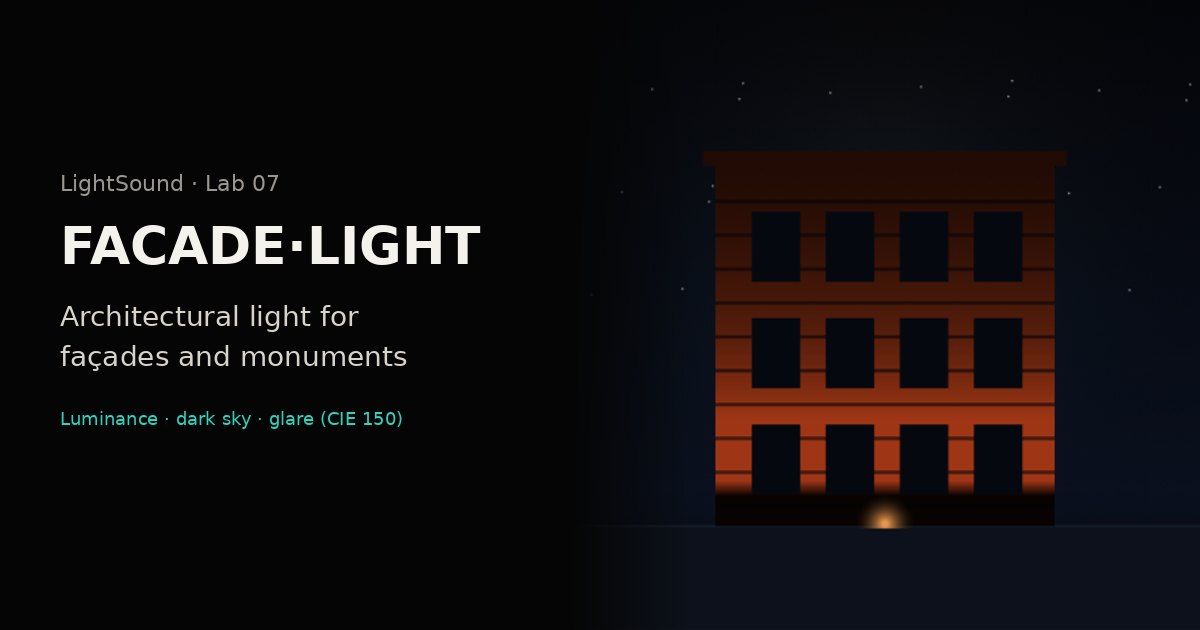
Night lighting can reveal the relief of a historic façade or the volume of a sculpture — or flatten it, dazzle passers-by and wash the stars out of the sky. The laboratory teaches both sides at once: the artistic choice of technique, colour temperature and direction, and the measurable limits that keep light where it belongs.
Historic façade, portico, park sculpture or arch over water; travertine, plaster, brick or bronze; environmental zone E1–E4.
Grazing, floodlight and accent presets as starting points for your own solution.
Setback, aiming angle, beam angle, flux, framing optics and colour temperature.
The lit object at night and a section showing the beam, the light that misses the object and the pedestrian’s eye.
Average illuminance, luminance against the zone limit, uniformity, direct light into the sky and intensity towards pedestrians.
A PNG with the scene, settings and verdicts, and a JSON file for analysis.
The calculation is a simplified teaching model: one luminaire with an even beam, a diffuse surface and a two-dimensional section that takes the width of the beam into account. The limits are those of CIE 150:2017 for the period before curfew. Real projects are calculated from manufacturers’ photometric files and checked on site.
If you use the laboratories in teaching or research, please cite the collection:
Freedman, D. A. (2026). LightSound Labs: Open Interactive Laboratories of Light, Colour, Sound and Perception (Version 1.0). Scientific and Educational Institute of Multidisciplinary Research «SMART City», Uzhhorod National University. Zenodo. https://doi.org/10.5281/zenodo.24308316
LightSound project
Concept and direction: Daniel A. Freedman — stage director, founder of the Lux Aeterna Light and Music Theatre
Published on LightSound — a digital ecosystem-school for interdisciplinary research
Scientific and Educational Institute of Multidisciplinary Research “SMART City”, Uzhhorod National University · svitlozvuk.freedanman.com · 2026