Lighting schemes
Classic three-point, drama / chiaroscuro, Rembrandt 45° and backlit silhouette as starting points.
LightSound Lab 06 · Study laboratory
A trainer for lighting designers: move key, fill, back and cyclorama lights around an object, change the optics, height and colour temperature, and see at once how the volume, the shadow and the measured illuminance respond.
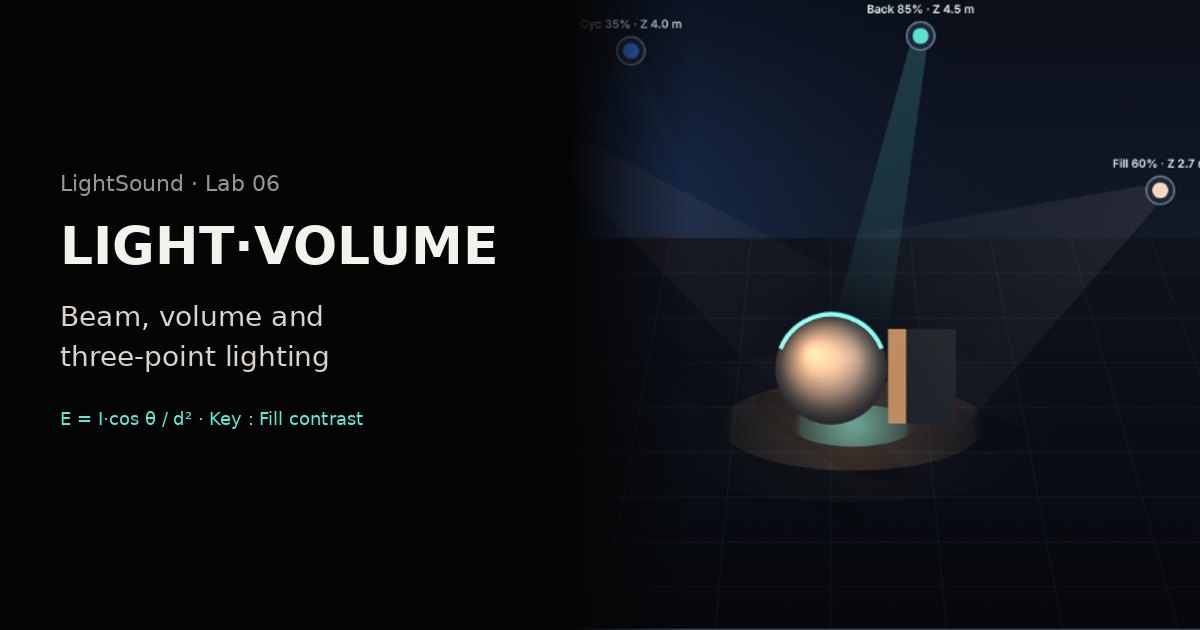
Light shapes form: the same object looks flat, sculpted or dramatic depending on where the lights hang, how wide their beams are and how strong each one is. In the laboratory students see this and measure it at the same time — the picture shows the volume and the shadow, the numbers show distance, pool size, illuminance and contrast.
Classic three-point, drama / chiaroscuro, Rembrandt 45° and backlit silhouette as starting points.
Key, fill, back and cyclorama lights that you drag with the mouse, a finger or the arrow keys.
Three objects — sphere and block, sculptural portrait, colonnade — plus haze density and ambient light.
Profile / Spot, Fresnel / Wash or Beam; dimmer, beam angle, hanging height and colour temperature or a colour filter.
Distance, pool diameter, luminous intensity, illuminance on the beam and on the horizontal, angle of incidence and shadow length.
A PNG with the scene and a table of every fixture, ready to hand in.
The calculations are simplified for teaching: light is taken as even within the beam angle (I = Φ / Ω) with no losses in the optics, the centre of the object is 1 m high, and beams, pools and shadows are drawn schematically. The numbers show orders of magnitude and relationships, not the data of a specific fixture.
If you use the laboratories in teaching or research, please cite the collection:
Freedman, D. A. (2026). LightSound Labs: Open Interactive Laboratories of Light, Colour, Sound and Perception (Version 1.0). Scientific and Educational Institute of Multidisciplinary Research «SMART City», Uzhhorod National University. Zenodo. https://doi.org/10.5281/zenodo.24308316
LightSound project
Concept and direction: Daniel A. Freedman — stage director, founder of the Lux Aeterna Light and Music Theatre
Published on LightSound — a digital ecosystem-school for interdisciplinary research
Scientific and Educational Institute of Multidisciplinary Research “SMART City”, Uzhhorod National University · svitlozvuk.freedanman.com · 2026